
What are excavator booms made of?
Excavator booms are primarily made from high-strength low-alloy steel, particularly grades Q355 and Q460, which provide the perfect balance of strength, durability and weight management,necessary forheavy applications. These reliable components form the basis of modern excavation equipment, especially in long-reach excavators where material quality becomes even more important. The extended reach capability, often stretching to 18 meters or more, requires materials that can withstand enormous stress while maintaining structural integrity during service.
When examining a Long Range Boom nearby, you'll notice the precision engineering that goes into its design. The main structure of the boom consists of carefully crafted steel plates welded together to form a box-section structure. However, this is not ordinary steel—manufacturers choose specific alloys that are refined through complex metallurgical processes. The material composition typically includes manganese, carbon and small amounts of chromium, nickel and molybdenum to enhance mechanical properties. This specialized compound allows the boom to handle the significant bending moments and twisting forces encountered during digging, lifting and pumping operations without compromising safety or productivity.
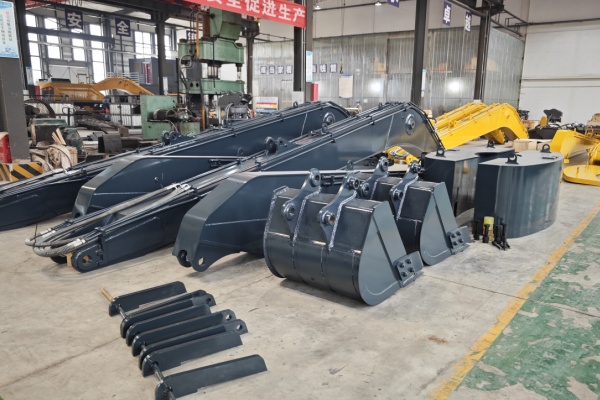
High Strength Low Alloy Steel (HSLA): Q355/Q460
Composition and properties of the material
The foundation of any high-quality long-haul excavator begins with selecting the appropriate grades of steel. Q355 and Q460, designations from the Chinese GB standard, have become industry standards for heavy equipment manufacturing. The numbers indicate the minimum strength of steel, measured in megapascals (MPa). Q355 steel provides a strength of approximately 355 MPa, while Q460 provides increased strength at 460 MPa.
What makes these steels particularly suitable for excavator components is their carefully balanced chemical composition. A typical Q355 steel contains 0.20% carbon, 1.0-1.6% manganese, 0.55% silicon, and trace amounts of phosphorus and sulfur. The Q460 variant typically contains similar elements, but with slightly adjusted ratios to achieve higher strength characteristics. This precise formulation creates materials that exhibit an excellent strength-to-weight ratio, which is critical for high coverage applications where every pound counts.
Manufacturing engineers at companies like Tiannuo Machinery understand that choosing materials is a careful balancing act. While higher strength steels may seem preferable, they must consider factors beyond simple strengths, including:
① Weldability and ease of manufacture
② Resistant to crack propagation
③ Cyclic fatigue
④ Consideration of costs and availability of materials
⑤ Corrosion resistance under various working conditions
The preference for Q355 and Q460 steels is due to their excellent compromise between these competing factors, providing reliable performance under a variety of operating conditions.
Production process
Transforming raw steel into a finished, long-life boom excavator involves complex manufacturing processes that preserve and enhance the material's inherent properties. The process typically begins with large steel plates of a specific thickness—from 8 mm to 25 mm, depending on the component's design requirements.
These plates are precision-cut using CNC plasma or laser cutting systems, ensuring the dimensional accuracy required for subsequent assembly. The cut parts are then transferred to forming stations, where hydraulic presses bend them into the specific shapes required for the final product.boom sectionsThis cold forming process must be carefully controlled to avoid introducing stress concentrations that could become failure points during maintenance.
The most critical stage occurs during the welding phase. Manufacturers use specialized welding procedures that take into account the metallurgical properties of HSLA steels. Multi-pass welding methods with strict heat input control prevent problems such as hydrogen embrittlement or excessive hardening in heat-affected areas. Premium manufacturers use:
① Flux core arc welding for deep penetration into critical joints
② Submerged arc welding for longitudinal seams
③ Gas metal arc welding for fasteners and brackets
④ Comprehensive non-destructive testing, including ultrasonic and magnetic particle inspection
Tiannuo's approach to boom manufacturing emphasizes these quality-focused processes, particularly for their extended-range models designed for specialized applications in rail maintenance and construction projects.
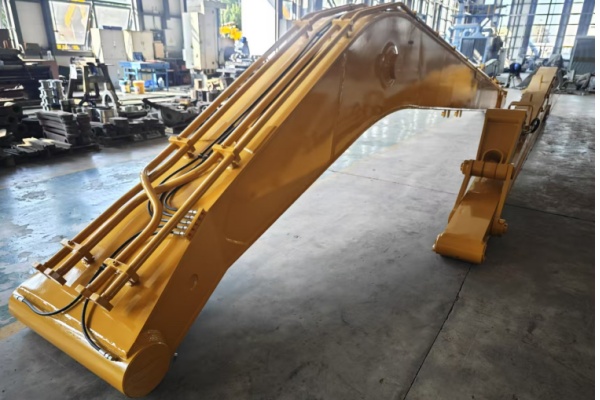
Stress distribution analysis
Engineering long-range excavators requires a sophisticated understanding of how forces are distributed throughout the structure during operation. Modern design methodologies utilize finite element analysis (FEA) to determine stress concentrations and optimize material utilization accordingly.
the design of the box section of the boom is not uniform along its entire length; Strategic changes in plate thickness directly respond to expected stress patterns. Areas near pivot points and hydraulic cylinder mounts typically include thicker material or additional reinforcement plates. This variable thickness approach optimizes the weight-to-strength ratio while maintaining safety margins.
For extended coverage applications, the voltage profile becomes even more complex. Boom experiences:
① Primary bending moments that increase sharply with reaching distance
② Rotating forces during turning operations
③ Dynamic impact load occurs when the bucket comes into contact with the material
④ Cyclic load causing fatigue during repetitive operations
Engineers must consider all these factors when determining material specifications. Q355/Q460 steel provides the necessary mechanical properties to withstand these complex loads while maintaining the structural integrity necessary for safe operation, especially in demanding environments such as railway construction sites or mining operations.
Quenching and scorching
Although they do not apply to the entire boom structure, some high voltage components in the boom assembly may be subject to extinguishing and caking. This process involves heating the steel to its austenitizing temperature (usually 845-870 °C), rapidly cooling it in oil or water (quenching), and then reheating it to a lower temperature (quenching).
The result is a material with increased hardness, wear resistance, and strength, ideal for components such as pin connections, housings, and cylinder mounting points. The precise annealing temperature determines the final balance between hardness and strength, allowing engineers to fine-tune the material's properties.for specific applications.
Modern excavator manufacturers often use selective heat treatment, focusing these more intensive processes on components that will experience the highest concentrations of wear or stress. This targeted approach optimizes performance while controlling manufacturing costs and complexity.
Improving mechanical properties
The ultimate goal of heat treatment in excavator boom manufacturing is to enhance specific mechanical properties that directly impact performance and durability. When performed correctly, these heat treatments can significantly improve:
① Performance and tensile strength
② Impact resistance and durability
③ Fatigue life under cyclic loading
④ Wear resistance at connection points
Dimensional stability during operation
For excavators used over long distances, these improvements are especially valuable. The extended reach creates increased torques that test the material's limits during daily operation. Railroad maintenance, demolition work, and heavy construction applications all place high demands on these components.
Heat treatment represents a critical link between material selection and actual field performance. Even the highest quality base materials cannot reach their full potential without proper heat treatment. Tiannuo's manufacturing protocols incorporate these heat treatment best practices to ensure that their off-site booms meet the stringent requirements of clients in specialist sectors such as railway construction and maintenance.
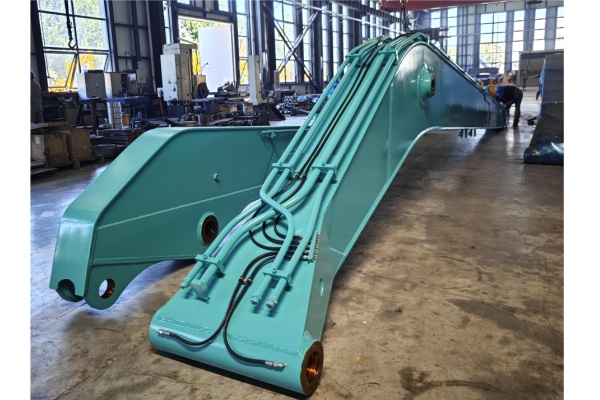
Surface treatment
Protective coatings
Duration of operationexcavators with longcoverage largely depends on its ability to withstand harsh environmental conditions. While the base material provides structural integrity, protective coatings protect against corrosion, abrasion and UV degradation that would otherwise gradually erode the component.
Modern excavator manufacturers are introducing multi-layer coating systems, typically consisting of:
① Surface preparation by grain blasting or shot blasting to create an optimal profile for coating adhesion
② Application of zinc-rich primer providing galvanic protection
③ Highly built epoxy intermediate coating for barrier protection
④ Polyurethane or polysiloxane coating for UV resistance and aesthetic finish
These systems provide comprehensive protection against various threats, including:
① Atmospheric corrosion from moisture and pollutants
② Chemical exposure in the industrial environment
③ Abrasion from contact with soil and rock
④ UV degradation, which may compromise the integrity of the coating
For specialized applications such as railway maintenance, where equipment may be subject to unique environmental challenges such as electrical conductivity issues near electrified rails, manufacturers like Tiannuo develop custom coating specifications to meet these specific requirements.
Wear-resistant procedures
Areas of the boom that are in direct contact with abrasive materials require additional protection beyond standard paint systems. Modern excavator booms incorporate several specialized wear-resistant treatments, particularly at bucket attachment points and other high-wear areas.
These treatments may include:
① Rigidly addressed through welded overlay with specialized alloys
② Thermal spray coatings using tungsten carbide or chromium oxide
③ Nitriding or carbonization of the surface hardening
④ Removable wear plates at critical contact points
The application of these treatment methods must balance wear protection with structural integrity considerations. For example, excessive rigidity can create undesirable heat-affected zones or residual stresses if not properly managed during application.
For long-reach excavator designs, wear pattern analysis becomes more complex due to the altered geometry and force distribution. Engineers must anticipate how the extended reach alters the interaction between the boom and its working environment, adjusting wear protection strategies accordingly.